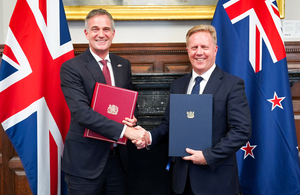
This Joint Statement follows the meeting of the Minister for Trade and Investment of New Zealand and Secretary of State for Business and Trade of the United Kingdom on 1 June 2026.
At their meeting, the Ministers opened the third Joint Committee of the New Zealand-United Kingdom Free Trade Agreement (FTA) and reaffirmed the strength of the New Zealand–United Kingdom trade relationship which reached a record £4.0bn or NZ$7.4bn of trade in goods and services in 2025.
They noted this reflects the strength of the FTA, which celebrated three years since its entry into force on 31 May 2023, and its continued delivery of tangible benefits to businesses and consumers.
In 2025, £675.1m or NZ$1,529.6m of traded goods successfully used preferential tariffs; i.e. around 91.5% of goods traded between the UK and New Zealand made use of preferences where one was available. High utilisation of preferential tariffs shows businesses are taking full advantage of the benefits of the FTA – reducing costs, improving market competitiveness and supporting trade growth.
Between Jan and Dec 2025:
- 88.5% of goods imports into New Zealand from the UK used preferential tariffs. Had this trade occurred at standard Most Favoured Nation (MFN) tariff rates, it could have encountered an additional £7.9m or NZ$17.9m in duties.
- 92.4% of goods imports into the UK from New Zealand used preferential tariffs. Had this trade occurred at standard MFN tariff rates, it could have encountered an additional £98.4m or NZ$222.9m in duties.
Ministers noted continued progress under the FTA and ongoing cooperation across its breadth.
They welcomed advancements on a tariff rate quota data sharing arrangement between the New Zealand Meat Board and HM Revenue and Customs and noted the Joint Understanding reached by the UK and New Zealand on improving the terms of trade for dealcoholised and partially dealcoholised wines and committing to make as much progress as possible towards a mutually satisfactory outcome over the next year. Ministers also welcomed significant progress on the review of the digital chapter and look forward to concluding discussions and agreeing an outcome that supports shared ambitions for digital trade growth.
They agreed that the Comprehensive and Progressive Agreement for Trans-Pacific Partnership (CPTPP) strengthens connections between the UK, New Zealand, and other Parties to the Agreement. Ministers reaffirmed their commitment to the CPTPP’s expansion via the accession of economies able to meet the Agreement’s high standards, the upgrading of the Agreement to ensure it remains of a high quality, and expanding the reach of the Agreement through the CPTPP-EU and CPTPP-ASEAN Dialogues to facilitate trade and support the international trading system.
In an increasingly uncertain global environment, the Ministers underscored that open and rules-based trade is central to prosperity and economic security, and reaffirmed their commitment to defend, strengthen, and modernise the rules-based multilateral trading system.
They reaffirmed the importance of a strong and effective World Trade Organization, at the core of the multilateral trading system, and the need to work together with urgency to progress, an inclusive and transparent WTO Reform agenda.
Ministers noted the importance of advancing gender equality through trade. The UK announced its intention to begin the formal process to join the Global Trade and Gender Arrangement (GTAGA), underscoring the UK’s commitment to ensuring that international trade works for everyone.
They welcomed the signing of a new bilateral Double Tax Agreement to better promote cross border trade and investment between the UK and New Zealand, by eliminating double taxation and improving certainty for taxpayers.
Ministers committed to continued engagement to progress opportunities under the FTA and identified environment, inclusive, digital and services trade as priorities for further cooperation in the year ahead.